


本次先写代码部分。跳过1,2章节。看兴趣补充吧。
本次code part是要写一个神经转移式依存句法分析。
基础概念:依存分析器通过栈、缓冲区和依存列表维护部分分析状态,支持 SHIFT(缓冲区首词入栈)、LEFT-ARC(栈次顶词依存于栈顶词)、RIGHT-ARC(栈顶词依存于次顶词)三种转移操作。
具体子任务
栈:当前正在处理的单词。
缓冲区: 待处理的单词缓冲区。
依存列表: 解析器预测的依赖项列表。
起初,栈中只包含ROOT,依赖列表为空,缓冲区按顺序包含句子的所有单词。在每一步中,解析器都会对部分解析结果应用一个转换,直到缓冲区为空且栈的大小为1。
• SHIFT:从缓冲区中移除第一个单词,并将其压入栈中。
• LEFT-ARC:将栈上的第二个(倒数第二个添加的)项目标记为第一个项目的依存项,并从栈中移除第二个项目,同时将“第一个词→第二个词”的依存关系添加到依存列表中。
• RIGHT-ARC:将栈上的第一个(最近添加的)项目标记为第二个项目的从属项,并从栈中移除第一个项目,同时将第二个词→第一个词的依存关系添加到依存关系列表中。
For example


一个包含n个单词的句子需要2n步,前n步进行shift,n-2n步骤进行SHIFT,LEFT-ARC.
code1 initilize Partial Parse
为每个句子创建一个PartialParse对象。
函数parse_step 接收模型预测的字符串"S""LA""RA",我们需要维护对应的栈,缓冲区,依存关系。
minibatch_parse 函数:
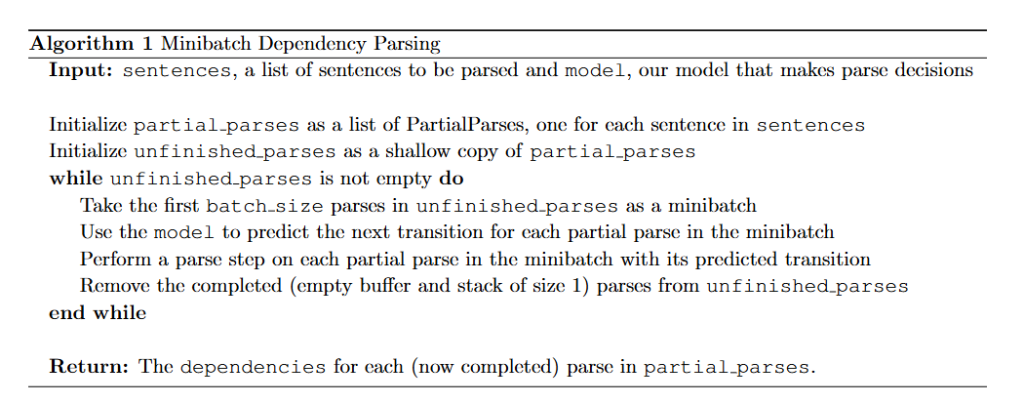
这里最讨厌的是没有给模型预测的接口,也不知道模型预测输出是什么。
class PartialParse(object):
    def __init__(self, sentence):
        """Initializes this partial parse.

        @param sentence (list of str): The sentence to be parsed as a list of words.
                                        Your code should not modify the sentence.
        """
        # The sentence being parsed is kept for bookkeeping purposes. Do NOT alter it in your code.
        self.sentence : list[str] = sentence
        self.stack : list[str] = ["ROOT"]
        self.buffer : list[str] = list(sentence)
        self.dependencies : list[tuple[str, str]] = []


    def parse_step(self, transition):
        """Performs a single parse step by applying the given transition to this partial parse

        @param transition (str): A string that equals "S", "LA", or "RA" representing the shift,
                                left-arc, and right-arc transitions. You can assume the provided
                                transition is a legal transition.
        """
        ### YOUR CODE HERE (~7-12 Lines)
        ### TODO:
        ###     Implement a single parsing step, i.e. the logic for the following as
        ###     described in the pdf handout:
        ###         1. Shift
        ###         2. Left Arc
        ###         3. Right Arc
        if transition == "S":
            self.stack.append(self.buffer.pop(0)) # shift the first word in the buffer to the stack
        elif transition == "LA":
            if len(self.stack) < 2:
                raise ValueError("Left arc transition requires at least 2 items on the stack")
            self.dependencies.append((self.stack[-1], self.stack[-2]))
            self.stack.pop(-2)  #remove
        elif transition == "RA":
            if len(self.stack) < 2:
                raise ValueError("Right arc transition requires at least 2 items on the stack")
            self.dependencies.append((self.stack[-2], self.stack[-1]))
            self.stack.pop(-1)

        ### END YOUR CODE

    def parse(self, transitions):
        """Applies the provided transitions to this PartialParse

        @param transitions (list of str): The list of transitions in the order they should be applied

        @return dependencies (list of string tuples): The list of dependencies produced when
                                                        parsing the sentence. Represented as a list of
                                                        tuples where each tuple is of the form (head, dependent).
        """
        for transition in transitions:
            self.parse_step(transition)
        return self.dependencies


def minibatch_parse(sentences, model, batch_size):
    """Parses a list of sentences in minibatches using a model.

    @param sentences (list of list of str): A list of sentences to be parsed
                                            (each sentence is a list of words and each word is of type string)
    @param model (ParserModel): The model that makes parsing decisions. It is assumed to have a function
                                model.predict(partial_parses) that takes in a list of PartialParses as input and
                                returns a list of transitions predicted for each parse. That is, after calling
                                    transitions = model.predict(partial_parses)
                                transitions[i] will be the next transition to apply to partial_parses[i].
    @param batch_size (int): The number of PartialParses to include in each minibatch


    @return dependencies (list of dependency lists): A list where each element is the dependencies
                                                    list for a parsed sentence. Ordering should be the
                                                    same as in sentences (i.e., dependencies[i] should
                                                    contain the parse for sentences[i]).
    """
    dependencies = []

    ### YOUR CODE HERE (~8-10 Lines)
    ### TODO:
    ###     Implement the minibatch parse algorithm.  Note that the pseudocode for this algorithm is given in the pdf handout.
    ###
    ###     Note: A shallow copy (as denoted in the PDF) can be made with the "=" sign in python, e.g.
    ###                 unfinished_parses = partial_parses[:].
    ###             Here `unfinished_parses` is a shallow copy of `partial_parses`.
    ###             In Python, a shallow copied list like `unfinished_parses` does not contain new instances
    ###             of the object stored in `partial_parses`. Rather both lists refer to the same objects.
    ###             In our case, `partial_parses` contains a list of partial parses. `unfinished_parses`
    ###             contains references to the same objects. Thus, you should NOT use the `del` operator
    ###             to remove objects from the `unfinished_parses` list. This will free the underlying memory that
    ###             is being accessed by `partial_parses` and may cause your code to crash.

    # 初始化部分解析列表:为每个句子创建一个PartialParse对象
    # Initialize partial parses as a list of PartialParses, one for each sentence in sentences
    partial_parses = [PartialParse(sentence) for sentence in sentences]  # 使用列表推导式,为sentences中的每个句子创建一个PartialParse实例
    # 初始化未完成的解析列表:作为partial_parses的浅拷贝
    # Initialize unfinished parses as a shallow copy of partial parses
    unfinished_parses = partial_parses[:]  # 使用切片操作创建浅拷贝,两个列表引用相同的PartialParse对象

    # 当未完成的解析列表不为空时,继续循环处理
    # while unfinished parses is not empty do
    while unfinished_parses:  # 只要unfinished_parses列表不为空,就继续执行循环
        # 从未完成的解析列表中取出前batch_size个解析作为一个小批次
        # Take the first batch size parses in unfinished parses as a minibatch
        mini_batch_partial_parses = unfinished_parses[:batch_size]  # 使用切片获取前batch_size个元素作为小批次

        # 使用模型为小批次中的每个部分解析预测下一个转移操作
        # Use the model to predict the next transition for each partial parse in the minibatch
        transitions = model.predict(mini_batch_partial_parses)  # 调用模型的predict方法,返回每个部分解析对应的下一个转移操作列表

        # 对小批次中的每个部分解析执行其预测的转移操作
        # Perform a parse step on each partial parse in the minibatch with its predicted transition
        for partial_parse, transition in zip(mini_batch_partial_parses, transitions):  # 使用zip将部分解析和对应的转移操作配对
            partial_parse.parse_step(transition)  # 对每个部分解析执行一步解析操作(SHIFT、LEFT-ARC或RIGHT-ARC)
        # 从未完成的解析列表中移除已完成的解析(缓冲区为空且栈大小为1)
        # Remove the completed (empty buffer and stack of size 1) parses from unfinished parses
        new_unfinished_parses = []  # 创建一个新的空列表用于存储未完成的解析
        for pp in unfinished_parses:  # 遍历当前未完成的解析列表中的每个部分解析
            if len(pp.buffer) > 0 or len(pp.stack) > 1:  # 如果缓冲区不为空或栈大小大于1,说明解析尚未完成
                new_unfinished_parses.append(pp)  # 将该部分解析添加到新的未完成列表中
        unfinished_parses = new_unfinished_parses  # 更新未完成的解析列表,移除已完成的解析

    # 为每个句子返回依赖关系列表
    # Return dependencies for each sentence
    for pp in partial_parses:  # 遍历所有部分解析(包括已完成的)
        dependencies.append(pp.dependencies)  # 将每个部分解析的依赖关系列表添加到结果列表中

    ### END YOUR CODE

    return dependencies
code2 model
我们现在要训练一个神经网络,使其能够在给定栈、缓冲区和依赖关系状态的情况下,预测下一步应该应用哪种转换。
首先,模型提取一个代表当前状态的特征向量。我们将使用原始神经依存句法分析论文中提出的特征集:《使用神经网络的快速准确依存句法分析器》。提取这些特征的函数已在utils/parser utils.py中为你实现。该特征向量由一系列标记组成(例如,栈中的最后一个词、缓冲区中的第一个词、栈中倒数第二个词的依存词——如果有的话,等等)。它们可以表示为一个整数列表w=[w1, w2, ..., wm],其中m是特征的数量,每个0 ≤wi<|V|是词汇表中某个标记的索引(|V|是词汇表大小)。然后,我们的网络会为每个词查找一个嵌入,并将它们连接成一个单一的输入向量:
x = [E_{w1} , ..., E_{wm} ] ∈ R^{dm}即对单词进行token化。
模型结构是:
h = ReLU(xW + b1)\\l = hU + b_2 \\ \hat{y} = softmax(l)class ParserModel(nn.Module):
""" Feedforward neural network with an embedding layer and two hidden layers.
The ParserModel will predict which transition should be applied to a
given partial parse configuration.
PyTorch Notes:
- Note that "ParserModel" is a subclass of the "nn.Module" class. In PyTorch all neural networks
are a subclass of this "nn.Module".
- The "__init__" method is where you define all the layers and parameters
(embedding layers, linear layers, dropout layers, etc.).
- "__init__" gets automatically called when you create a new instance of your class, e.g.
when you write "m = ParserModel()".
- Other methods of ParserModel can access variables that have "self." prefix. Thus,
you should add the "self." prefix layers, values, etc. that you want to utilize
in other ParserModel methods.
- For further documentation on "nn.Module" please see https://pytorch.org/docs/stable/nn.html.
"""
def __init__(self, embeddings, n_features=36,
hidden_size=200, n_classes=3, dropout_prob=0.5):
""" Initialize the parser model.
@param embeddings (ndarray): word embeddings (num_words, embedding_size)
@param n_features (int): number of input features
@param hidden_size (int): number of hidden units
@param n_classes (int): number of output classes
@param dropout_prob (float): dropout probability
"""
super(ParserModel, self).__init__()
self.n_features = n_features
self.n_classes = n_classes
self.dropout_prob = dropout_prob
self.embed_size = embeddings.shape[1]
self.hidden_size = hidden_size
self.embeddings = nn.Parameter(torch.tensor(embeddings))
### YOUR CODE HERE (~9-10 Lines)
### TODO:
### 1) Declare `self.embed_to_hidden_weight` and `self.embed_to_hidden_bias` as `nn.Parameter`.
### Initialize weight with the `nn.init.xavier_uniform_` function and bias with `nn.init.uniform_`
### with default parameters.
### 2) Construct `self.dropout` layer.
### 3) Declare `self.hidden_to_logits_weight` and `self.hidden_to_logits_bias` as `nn.Parameter`.
### Initialize weight with the `nn.init.xavier_uniform_` function and bias with `nn.init.uniform_`
### with default parameters.
###
### Note: Trainable variables are declared as `nn.Parameter` which is a commonly used API
### to include a tensor into a computational graph to support updating w.r.t its gradient.
### Here, we use Xavier Uniform Initialization for our Weight initialization.
### It has been shown empirically, that this provides better initial weights
### for training networks than random uniform initialization.
### For more details checkout this great blogpost:
### http://andyljones.tumblr.com/post/110998971763/an-explanation-of-xavier-initialization
###
### Please see the following docs for support:
### nn.Parameter: https://pytorch.org/docs/stable/nn.html#parameters
### Initialization: https://pytorch.org/docs/stable/nn.init.html
### Dropout: https://pytorch.org/docs/stable/nn.html#dropout-layers
###
### See the PDF for hints.
#! Step1
#! 构建一个神经网络,首先使用nn.Parameter声明一个权重矩阵和偏置向量,
#! 然后使用nn.init.xavier_uniform_初始化权重矩阵,使用nn.init.uniform_初始化偏置向量
#? 怎么确定矩阵的行列:1.作用:xW+b 2.输入维度 × 输出维度: 输入是n_features * self.embed_size,输出是hidden_size
self.embed_to_hidden_weight=nn.Parameter(torch.empty(n_features * self.embed_size, hidden_size))
self.embed_to_hidden_bias=nn.Parameter(torch.empty(hidden_size))
#! 初始化权重矩阵和偏置向量
nn.init.xavier_uniform_(self.embed_to_hidden_weight)
nn.init.uniform_(self.embed_to_hidden_bias)
#! Step2
self.dropout=nn.Dropout(p=dropout_prob)
#! Step3
#? 为什么第二层输出是n_classes:因为要预测3种转移操作,所以输出是3
self.hidden_to_logits_weight=nn.Parameter(torch.empty(hidden_size,n_classes))
self.hidden_to_logits_bias=nn.Parameter(torch.empty(n_classes))
#! 初始化权重矩阵和偏置向量
nn.init.xavier_uniform_(self.hidden_to_logits_weight)
nn.init.uniform_(self.hidden_to_logits_bias)
### END YOUR CODE
def embedding_lookup(self, w):
""" Utilize `w` to select embeddings from embedding matrix `self.embeddings`
@param w (Tensor): input tensor of word indices (batch_size, n_features)
@return x (Tensor): tensor of embeddings for words represented in w
(batch_size, n_features * embed_size)
"""
### YOUR CODE HERE (~1-4 Lines)
### TODO:
### 1) For each index `i` in `w`, select `i`th vector from self.embeddings
### 2) Reshape the tensor using `view` function if necessary
###
### Note: All embedding vectors are stacked and stored as a matrix. The model receives
### a list of indices representing a sequence of words, then it calls this lookup
### function to map indices to sequence of embeddings.
###
### This problem aims to test your understanding of embedding lookup,
### so DO NOT use any high level API like nn.Embedding
### (we are asking you to implement that!). Pay attention to tensor shapes
### and reshape if necessary. Make sure you know each tensor's shape before you run the code!
###
### Pytorch has some useful APIs for you, and you can use either one
### in this problem (except nn.Embedding). These docs might be helpful:
### Index select: https://pytorch.org/docs/stable/torch.html#torch.index_select
### Gather: https://pytorch.org/docs/stable/torch.html#torch.gather
### View: https://pytorch.org/docs/stable/tensors.html#torch.Tensor.view
### Flatten: https://pytorch.org/docs/stable/generated/torch.flatten.html
x = None
#! w.view(-1):将索引w展平成一维
#! 依据扩展后的索引从self.embeddings的第0维(行)中选择索引对应的行。
#! (batch_size,n_features)-->(batch_size*n_features,embed_size)
x=torch.index_select(self.embeddings, 0, w.view(-1))
#! (batch_size*n_features,embed_size)-->(batch_size,n_features*embed_size)
#! view 函数:改变张量的形状,第0维:batch_size(保持批次维度)
#! -1 = (总元素数) / w.shape[0] n_features * embed_size
x=x.view(w.shape[0], -1)
### END YOUR CODE
return x
def forward(self, w):
""" Run the model forward.
Note that we will not apply the softmax function here because it is included in the loss function nn.CrossEntropyLoss
PyTorch Notes:
- Every nn.Module object (PyTorch model) has a `forward` function.
- When you apply your nn.Module to an input tensor `w` this function is applied to the tensor.
For example, if you created an instance of your ParserModel and applied it to some `w` as follows,
the `forward` function would called on `w` and the result would be stored in the `output` variable:
model = ParserModel()
output = model(w) # this calls the forward function
- For more details checkout: https://pytorch.org/docs/stable/nn.html#torch.nn.Module.forward
@param w (Tensor): input tensor of tokens (batch_size, n_features)
@return logits (Tensor): tensor of predictions (output after applying the layers of the network)
without applying softmax (batch_size, n_classes)
"""
### YOUR CODE HERE (~3-5 lines)
### TODO:
### Complete the forward computation as described in write-up. In addition, include a dropout layer
### as decleared in `__init__` after ReLU function.
###
### Note: We do not apply the softmax to the logits here, because
### the loss function (torch.nn.CrossEntropyLoss) applies it more efficiently.
###
### Please see the following docs for support:
### Matrix product: https://pytorch.org/docs/stable/torch.html#torch.matmul
### ReLU: https://pytorch.org/docs/stable/nn.html?highlight=relu#torch.nn.functional.relu
logits = None
#! Step1
x=self.embedding_lookup(w)
#! Step2
x=torch.matmul(x, self.embed_to_hidden_weight) + self.embed_to_hidden_bias
#! Step3
x=F.relu(x)
#! Step4
x=self.dropout(x)
#! Step5
x=torch.matmul(x, self.hidden_to_logits_weight) + self.hidden_to_logits_bias
#! Step6
logits=x
### END YOUR CODE
return logits
Comments NOTHING